
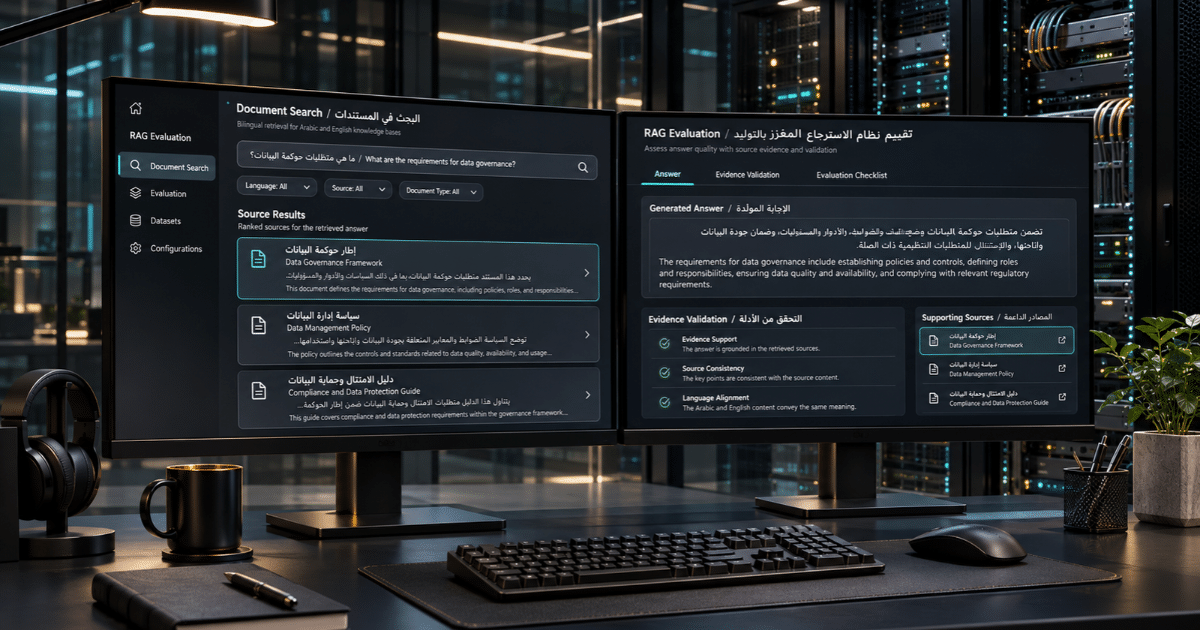
Arabic RAG evaluation checks whether an assistant finds the right evidence, cites passages that support its claims and handles questions the available documents cannot answer. Score these outcomes separately. An assistant can retrieve the correct policy and still omit an exception, quote an expired version or refuse a question it could have answered.
Start with real business tasks, approved Arabic and English documents and a clear expected outcome for each question. Then test the search results and the final response against the same case record. This gives your team a way to decide what to fix and whether the assistant is ready for wider use.
Why Should Businesses Evaluate an Arabic RAG Assistant?
Retrieval-augmented generation, or RAG, supplies a language model with relevant source material when a user asks a question. The quality of the response depends on what gets retrieved and how the model uses it. A convincing demo can miss the cases that matter in daily work, such as an outdated warranty clause or an English product code buried in an Arabic scan.
| Business Benefit | What the Evaluation Reveals |
|---|---|
| Reduce avoidable rework | Whether errors start in document extraction, search, answer writing or citation selection. |
| Make answers easier to verify | Whether staff can open the exact passage that supports a decision. |
| Protect service quality in Arabic | Whether formal, conversational and bilingual questions work across the tasks people actually perform. |
| Control rollout risk | Which failures need a fix, a narrower scope or human review before release. |
| Compare vendor proposals | Whether each supplier can demonstrate performance on the same approved cases and explain the failures. |
For a service desk, the practical question is whether agents spend less time checking an answer while still catching exceptions. Measure review time and corrections alongside response quality if efficiency is part of the business case.
How Do You Run an Arabic RAG Evaluation?
- Define the scope. Name the users, tasks, supported languages and document collections. Specify which actions are outside scope, such as authorising a refund.
- Freeze the test configuration. Record the model and prompt versions, index snapshot, document versions, retrieval settings and test account permissions.
- Write the expected result before running each case. Record the evidence and whether the assistant should answer, clarify, give a partial answer, decline or escalate.
- Inspect the passages actually supplied to the model. A relevant result returned by search may be dropped during ranking or context selection.
- Score the response. Check material claims, citations, missing conditions and the appropriateness of the action taken.
- Assign an owner and retest. Fix the failed component, then rerun affected cases and the core regression set.
Use development cases to adjust the system. Keep a separate final set for acceptance testing and avoid close variants of the same question across both sets. If the team repeatedly tunes against the final set, set aside a fresh set for the next formal comparison.
What Should an Arabic RAG Test Dataset Include?
Build the set around decisions your staff and customers need to make. Start with approved questions from the business team or anonymised examples reviewed by the data owner. Label both ordinary tasks and cases where an incorrect answer could have a material consequence.
| Test Query | What It Checks |
|---|---|
| ما شروط استبدال المنتج؟ | A formal Arabic question about product exchange conditions. |
| وش شروط تبديل المنتج؟ | Saudi dialect retrieval of the same formal policy. |
| هل يغطي الضمان جهاز X200؟ | An Arabic warranty question that must preserve the exact model identifier X200. |
| متى ينتهي الضمان؟ | Whether the assistant requests a product or purchase detail when the answer depends on it. |
For Arabic-English semantic search, test an Arabic query whose approved evidence is in English. Include specialist terms with more than one Arabic rendering. Check whether the response preserves the source’s units, dates, conditions and exceptions when explaining them in Arabic.
Cover the Documents Users Actually Rely On
Include clean documents, scans, tables and bilingual policies. Add superseded versions and questions that need evidence from more than one section. In an access test, use the same question with authorised and restricted test accounts and record what each account may retrieve.
A usable test record includes a case ID, task, language variety, user role, expected action, approved document version, page or section, required evidence and the claims a complete response must include. Add observed passages, output and reviewer verdict after the run.
How Do You Measure Arabic Retrieval Quality?
Inspect the ranked results before reviewing the answer. Agree what counts as evidence in advance. Label passages that establish the answer, including any separate exception or eligibility condition. Agree how to treat duplicates and equally valid alternative passages.
| Retrieval Metric | What It Measures | When It Helps |
|---|---|---|
| Hit Rate at k | Share of answerable test questions with at least one relevant passage among the first k results. | A quick check for whether search finds any useful evidence. |
| Recall@k | Share of the labelled relevant passages retrieved among the first k results for a question. | Checking completeness when a policy and its exception are stored separately. |
| Mean Reciprocal Rank | Average of 1 divided by the rank of the first relevant result, with zero for a miss within the evaluated list. | Checking whether the first useful passage appears early. |
Suppose a question needs two passages and the top five contain only one, at rank three. The case counts as a hit, its recall@5 is 50%, and its reciprocal rank is one-third. That distinction matters when the missing passage determines eligibility. These figures illustrate the metrics and do not describe a measured system.
Report the cutoff and denominators. Group results by Arabic variety, source format and task. Keep questions with no labelled evidence out of standard retrieval-recall averages and evaluate their response handling separately. When judging access restrictions, check what entered the model context even if the final answer appeared safe.
Diagnose Search Failures Before Changing the Model
If a scanned policy is missing from the results, inspect the extracted text first. Optical character recognition can misread a number or detach a table cell from its heading. If the text is intact, check indexing, filters, permissions, passage boundaries and ranking. For a query with a product code, compare keyword and semantic search on the same cases. Exact matches and meaning-based matches can serve different needs.
How Do You Check RAG Citation Accuracy?
Review the answer claim by claim. A citation passes when an authorised reader can locate the cited passage and that passage supports the attached claim at the level of detail stated. Opening the correct document is only the first check. Inspect the exact section, effective date, scope, exclusions and numbers.

Measure two different properties:
- Citation support checks how many checked claim–citation links point to evidence that supports the claim.
- Citation coverage checks how many material claims have at least one supporting citation.
Agree how to score jointly supported claims. If an answer needs two passages to establish a conclusion, assess the evidence together and record which citation was missing. Report claim errors separately from broken links, incorrect page references and inaccessible sources.
Arabic answer groundedness means the material statements follow the supplied evidence. A fluent translation can still change an eligibility condition or omit a negative. Have a reviewer check the Arabic meaning against the original passage, especially when the source is in English. Evaluate whether the answer is complete enough for the task as a separate judgement.
How Should an Assistant Handle Unanswerable Questions?
Unanswerable questions in RAG need an expected action. A question can be unanswerable because the collection is silent, because the user omitted a necessary detail or because the evidence is outside the user’s permissions. Those cases should not all receive the same response.
| Evidence Condition | Expected Response |
|---|---|
| No approved source supports the answer | State that the available sources do not establish the answer and direct the user to the appropriate channel when one exists. |
| A necessary detail is missing | Ask a targeted clarification that could make the question answerable. |
| Only part of the question is supported | Answer the supported portion, cite it and identify the unresolved part. |
| The evidence is restricted | Follow the access policy and avoid exposing restricted content or metadata. |
| Approved sources conflict | Apply an agreed source-precedence rule or escalate the conflict for review. |
For RAG refusal testing, track unsafe answers on cases that should be declined separately from unnecessary refusals on answerable cases. Use each case’s expected action to score it. A clarification should pass when the case calls for one and fail when enough information was already present. Keep the categories separate so that raising the refusal rate does not hide a decline in usefulness.
How Do You Score a Realistic Arabic Test Case?
Assume a Saudi service business uses an assistant to answer warranty questions. Its fictional warranty policy states that eligible devices can be returned within 14 days and that installed devices require inspection first. The following cases are illustrative and do not describe any company’s policy or measured results.
| Test Case | Expected Evidence and Action | Observed Output | Verdict and Next Test |
|---|---|---|---|
| هل أقدر أرجع الجهاز بعد التركيب؟ | Current return clause plus the inspection exception. Answer with the condition. | Finds and cites the return window only. Says the device can be returned within 14 days. | Retrieval incomplete and answer missing a material condition. Check whether the exception was indexed and ranked. |
| هل أقدر أرجع جهاز X200؟ | Current X200 policy and any applicable exceptions. | Retrieves the correct passage but cites an expired policy page. | Retrieval passes for this case. Citation fails. Inspect how source IDs are attached to claims. |
| كم قيمة التعويض عن تأخر التركيب؟ | No approved compensation amount. Decline the amount and route to support. | Supplies an amount without evidence. | Unsupported answer. Test abstention behaviour on no-evidence cases and plausible distractors. |
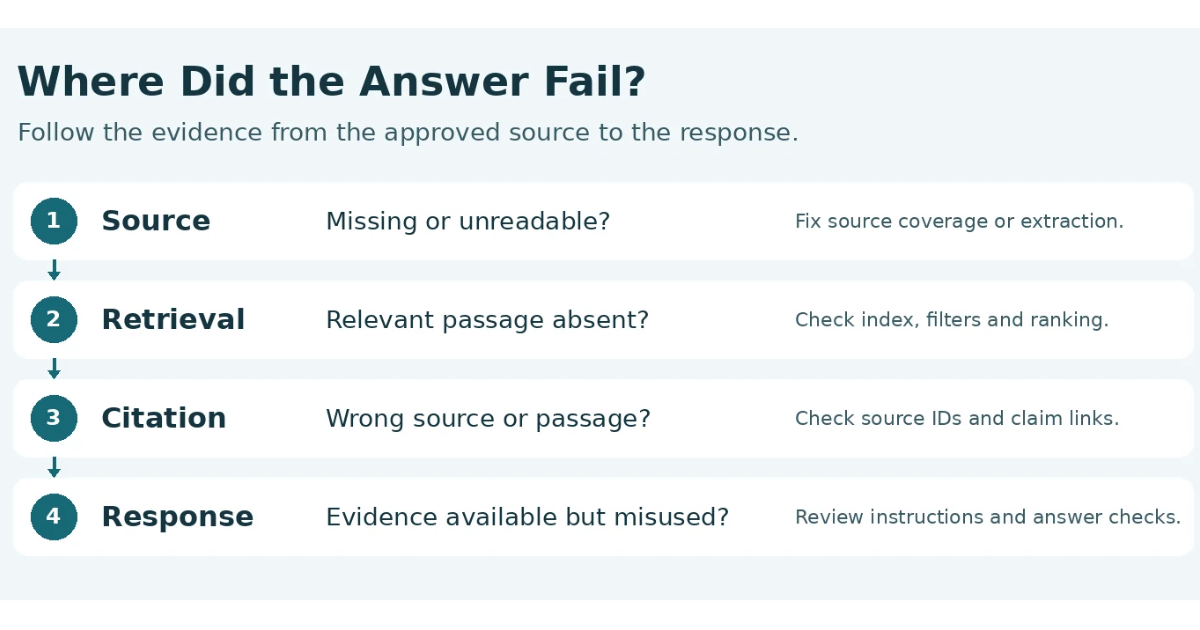
A corrected answer to the first case should make clear that an installed device requires inspection before return eligibility can be determined. If both passages reached the model and the condition was still omitted, investigate answer generation and instructions instead of changing search.
Which Failures Should Block Rollout?
Set acceptance criteria before the final test. An aggregate score cannot tell you whether a restricted document was exposed or a business-critical condition was omitted. Give those cases their own release rules.
An Arabic RAG evaluation should name who signs off on language quality, business correctness and access controls. If a critical case fails, record the exact result, narrow or pause the affected release scope and rerun the case after fixing it. Review related cases as well. One passing retest does not show that every variant is covered.
If your assistant relies on frequently updated business data, read our guide to AI/ML development with real-time data pipelines for more on keeping its source information current.
Pre-Launch Checklist
☐ The approved document versions, effective dates and source-precedence rules are recorded.
☐ The reserved test set covers real Arabic, dialect and bilingual tasks and the document formats users rely on.
☐ Retrieval results are inspected at the agreed cutoff and checked against the context sent to the model.
☐ Material claims are checked for citation support and citation coverage.
☐ Missing, ambiguous, partial and restricted cases have separately defined expected responses.
☐ Release blockers, evaluation thresholds and reviewers are named before the acceptance run.
☐ Corrections are retested and the core regression set still passes the agreed criteria.
☐ The handover identifies who updates sources, monitors errors and approves future releases.
Illustrative Case Study: A Bilingual Procurement Assistant
A hypothetical Saudi distributor pilots an internal assistant for supplier onboarding and purchase-order procedures. Staff ask questions in Arabic, but some approved instructions are in English. The pilot covers policy guidance. Live invoice status stays in the finance system.
The team reserves 48 cases before making changes. The groups below are mutually exclusive. Each count shows how many cases failed the named check. All counts are simulated to show how a team could record findings and make a release decision.
| Test Group | Initial Run | After Targeted Fix | What the Team Changed |
|---|---|---|---|
| 18 evidence retrieval cases | 6 misses | 2 misses | Preserved procedure codes in search and linked annexes to their parent policy. |
| 14 citation cases | 4 failures | 1 failure | Mapped citations to source passages and flagged superseded revisions. |
| 12 no-evidence or clarification cases | 3 wrong actions | 1 wrong action | Added a route to Finance for live status and clarified when to ask for a purchase-order ID. |
| 4 restricted-source cases | 1 exposure | 0 exposures | Applied role filtering before passages reached the model. |
In one test, the assistant quoted a supplier onboarding checklist but missed a separate annex for overseas suppliers. Reviewers found the annex in the approved collection and confirmed it had never reached the model. They logged a retrieval failure and reran related questions with different Arabic phrasings and supplier types.
The simulated team keeps rollout paused for users who could encounter the remaining policy and routing failures. Zero exposures on four restricted cases shows those checks passed on this run. The team adds role-change and cached-result tests before deciding whether to widen access.
A Reusable Evaluation Handover Record
For each material failure, keep a record that someone outside the pilot can reproduce. The entry below uses the illustrative procurement case.
| Field | Example Entry |
|---|---|
| Case and impact | PROC-017. Overseas supplier onboarding. The missing annex could change the documents requested. |
| Evidence and actual result | Current checklist and overseas supplier annex expected. Only the checklist reached the model. |
| Failure owner and fix | Search owner. Link the annex to its parent policy and confirm both passages reach the model. |
| Retest and sign-off | Rerun the original case, dialect variants and domestic supplier controls. Procurement confirms the answer and evidence before release. |
What Should You Ask an Arabic RAG Evaluation Partner?
Ask how the supplier will build a reserved test set, select Arabic reviewers, reproduce failures and report results by language and document type. Request a sample deliverable that separates retrieval, groundedness, citation and refusal outcomes. Clarify who prepares data, how reruns are priced and which files and configurations you receive at handover.
Discuss My Arabic RAG Evaluation
Tell Logical Creations what the assistant does, which document formats and Arabic varieties it supports, and the failure you need to investigate. Describe the use case and the stage of your project so the team can discuss a suitable evaluation scope.
Frequently Asked Questions
How Many Questions Do You Need for an Arabic RAG Test Set?
There is no universal count. Cover the main tasks, language varieties and high-impact failure modes first. Review the count in each group before trusting a percentage. If a group has only a few cases, use it to identify failure patterns and expand coverage before making broad claims.
Can an Automated Judge Reliably Score Saudi Arabic Answers?
Use automated scoring to triage larger runs. Compare its verdicts with those of qualified Arabic reviewers on a labelled sample, including dialect, mixed-language queries and subtle policy exceptions. Review disagreements and keep human sign-off for material errors and high-impact cases.
How Do You Score a Correct Answer With a Wrong Citation?
Record separate outcomes. The answer may pass factual correctness while failing citation support. When traceability is mandatory, the case can still fail the overall acceptance rule. Keep this distinction in the error log so the team knows whether to fix the response or its source mapping.
What If Two Approved Documents Give Conflicting Answers?
Check effective date, scope and ownership against a precedence rule agreed with the business. If the conflict remains unresolved, flag it for the policy owner. Update the collection once the owner resolves the issue and rerun questions that depend on both documents.
Should You Score Clarification Requests as Refusals?
Score clarification as its own action. It is appropriate when a missing detail could change the answer. It is unnecessary when the request is already specific enough. Track whether the assistant asks for the missing detail and can complete the task after the user supplies it.
Can an Arabic Question Be Answered From an English Source?
Yes, when policy allows cross-language answers and the source supports the claim. Check that the Arabic response preserves the meaning and cite the English original. Test exact identifiers and terms that could change meaning in translation.
Which Tests Should You Rerun After Updating the Search Index?
Rerun cases tied to added, changed and removed documents. Check stale citations and revoked access, then rerun representative Arabic, dialect and bilingual cases. If you changed extraction, chunking, ranking or an embedding model, compare results across the full core regression set.